
Lionfish: Capturing Movement in Steel

A lionfish sculpture was about to become one of Wayne Jeffery's more challenging commissions.
It started with a phone call from Boranup Gallery in Western Australia's South West.
“I have a couple here who love your lionfish table, but they'd like one as a standalone sculpture. And they've asked whether you can make it more lifelike.”
It was an interesting challenge, particularly as the couple owned a diving business and knew lionfish extremely well. They loved these extraordinary creatures so much that the lionfish had become their company emblem.
They knew exactly what they were looking for.
Getting Grumpy just right

Lionfish are remarkable subjects, with their delicate, fan-like fins, long spines and distinctive expressions. But capturing that character in steel is another matter.
Wayne went back to studying photographs, examining the fish from every angle and reconsidering how he had approached his earlier sculptures.
There were some surprising discoveries.
The angle of the head wasn't quite right. The fins needed to convey more movement.
Then came Wayne's biggest breakthrough.
He had always started his sculptures with a black undercoat. But the more he studied the lionfish, the more he realised that the dark base was working against him.
This fish needed to start with white.
It was a simple change, but one that transformed the finished piece. Suddenly the distinctive red markings and delicate fins came to life.
For Wayne, it was also a reminder that even after decades of making art, sometimes the most important thing is being willing to question how you've always done something.
Then came the challenge of bringing it together.

Each element had to be individually shaped and layered to create depth and movement. Working with heat and cooling meant continually checking that the dimensions and angles hadn't shifted.
Wayne describes his approach as “painting in motion” — creating something that changes as you move around it, rather than simply reproducing a flat image.
After weeks of studying, shaping and adjusting, the moment of truth arrived.
Hugh, the new owner, looked at the finished sculpture.
“Show me Grumpy. Yes, that's my Grumpy.”
Grumpy was the affectionate name the couple had given to the slightly displeased-looking lionfish they loved encountering on their dives.
Wayne had finally captured the character they knew so well.
Lionfish have a habit of travelling

This wasn't Wayne's first encounter with the species.
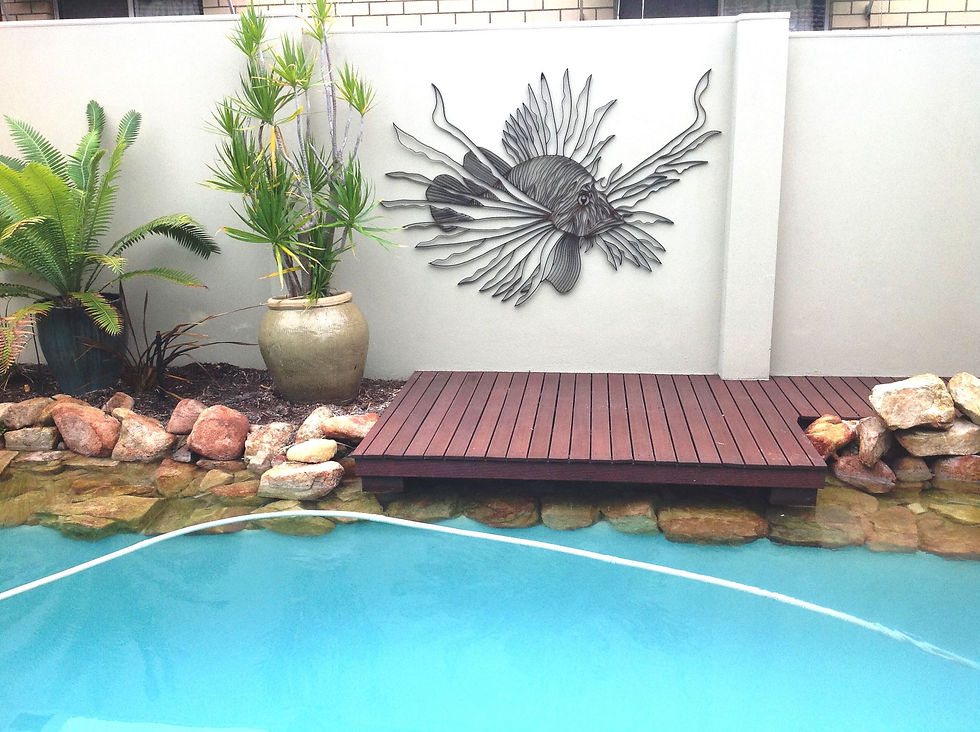
Over the years, lionfish have appeared in his work as standalone sculptures, a sculptural entrance table and even a large wall feature for a pool area in Claremont.
That wall piece, measuring approximately 1.6 × 1.8 metres, presented a different challenge: translating a three-dimensional creature into a relatively flat artwork.
By working with shaped steel flat bar, Wayne created an illusion of movement as the viewer walks past and the lines shift with their perspective.
And one earlier Lionfish had a particularly memorable journey.
While on display at the same Boranup Gallery, it caught the eye of a regular client who wanted to purchase it.
There was just one condition.
Could it be on his private jet to Florida by 9am the following morning?
The gallery owner personally made sure it reached the aircraft in time.
It did.
And somewhere in Florida, there's now a Wayne Jeffery Lionfish with quite a story behind it.
A new home, and another challenge

Grumpy has now settled into his new home, surrounded by some of the objects and collections his owners have treasured over the years.
And their story with Wayne isn't finished. They've asked him to create a special stand for their collection of fossil nautilus specimens - another opportunity to bring art and the natural world together.
It's a fitting continuation of a commission that began with a challenge.
Sometimes the most rewarding work begins with someone saying,
“We love it.
But could you make it even better?”

Wayne Jeffery creates original sculpture, functional art and architectural metalwork from his Western Australian studio.
Comments